Mdina | Malta
Mdina operates at a distinct register. Elevated inland and encircled by fortified walls, the former capital is quiet, enclosed, and contemplative. Limestone passageways narrow into corridors of shadow and light, where carved doorframes and wrought-iron lanterns punctuate the stone. The streets bend subtly, revealing façades in fragments rather than broad perspectives, encouraging movement at a slower, more attentive pace.
What distinguishes Mdina is intimacy. Streets are hushed; footsteps echo briefly against the walls before dissolving. Florals spill from balconies and inner courtyards, softening the severity of Baroque façades. The palette is restrained warm stone, muted timber, green shutters and the scale remains human. Windows feel closer, thresholds lower, proportions more personal.
There are no grand gestures here, only precision. The city turns inward, creating an atmosphere defined by containment and texture. Architecture feels residential rather than performative, protective rather than imposing. Mdina gathers itself within its walls, sustained by proportion, preservation, and quiet confidence.
Where to Stay in Mdina

The Xara Palace Relais & Châteaux
The Xara Palace Relais & Châteaux
Set within a 17th-century palazzo directly along Mdina’s bastions, The Xara Palace Relais & Châteaux carries the authority of its setting. The façade alone signals heritage, but interiors introduce refinement vaulted ceilings, antique detailing, stone staircases, and private terraces overlooking the countryside beyond the city walls. The architecture remains the focal point; furnishings are layered in a way that supports rather than competes with the building’s provenance.
There is an immediacy to the experience. Step outside and you are already within Mdina’s grid; retreat inside and the city quiets to near stillness. Early mornings unfold in near silence, the limestone streets still empty. Evenings settle quickly once day visitors depart, leaving the bastions to residents and guests. The property shapes the stay through proximity you are not adjacent to Mdina; you are within it.
The Xara Palace attracts a particular traveler: one who values heritage over novelty, intimacy over scale. It suits those who appreciate historical architecture not as backdrop, but as environment, travelers who prefer terraces with open countryside views to expansive resort grounds. This is a stay for the culturally attuned, for those who choose a destination because of its lineage and want to inhabit it fully, even if only for a few measured days.
Verdala Wellness Hotel – AX Privilege
Just beyond Mdina’s walls, Verdala Wellness Hotel – AX Privilege offers contrast through elevation and openness. Positioned on higher ground, the property overlooks sweeping Maltese countryside rather than dense stone corridors. The transition is immediate, fortified enclosure gives way to horizon and sky.
The aesthetic is contemporary and expansive - clean lines, glass, and uninterrupted views defining the architecture. Interiors are pared back, allowing landscape to take precedence. A dramatic infinity pool anchors the terrace, particularly striking at dusk when the countryside recedes into layered shadow and the sky carries the last trace of light. Where Mdina is inward and historic, Verdala is outward and restorative. The pairing allows travelers to experience both intimacy and breadth within minutes of one another.
Verdala suits the traveler who values balance: mornings spent tracing limestone passageways, afternoons recalibrating in open air. It appeals to those drawn to wellness not as trend, but as structure, measured movement, quiet terraces, and deliberate stillness. The stay is less about immersion in history and more about perspective stepping outside the walls to experience the island’s scale, then returning to them with renewed clarity.
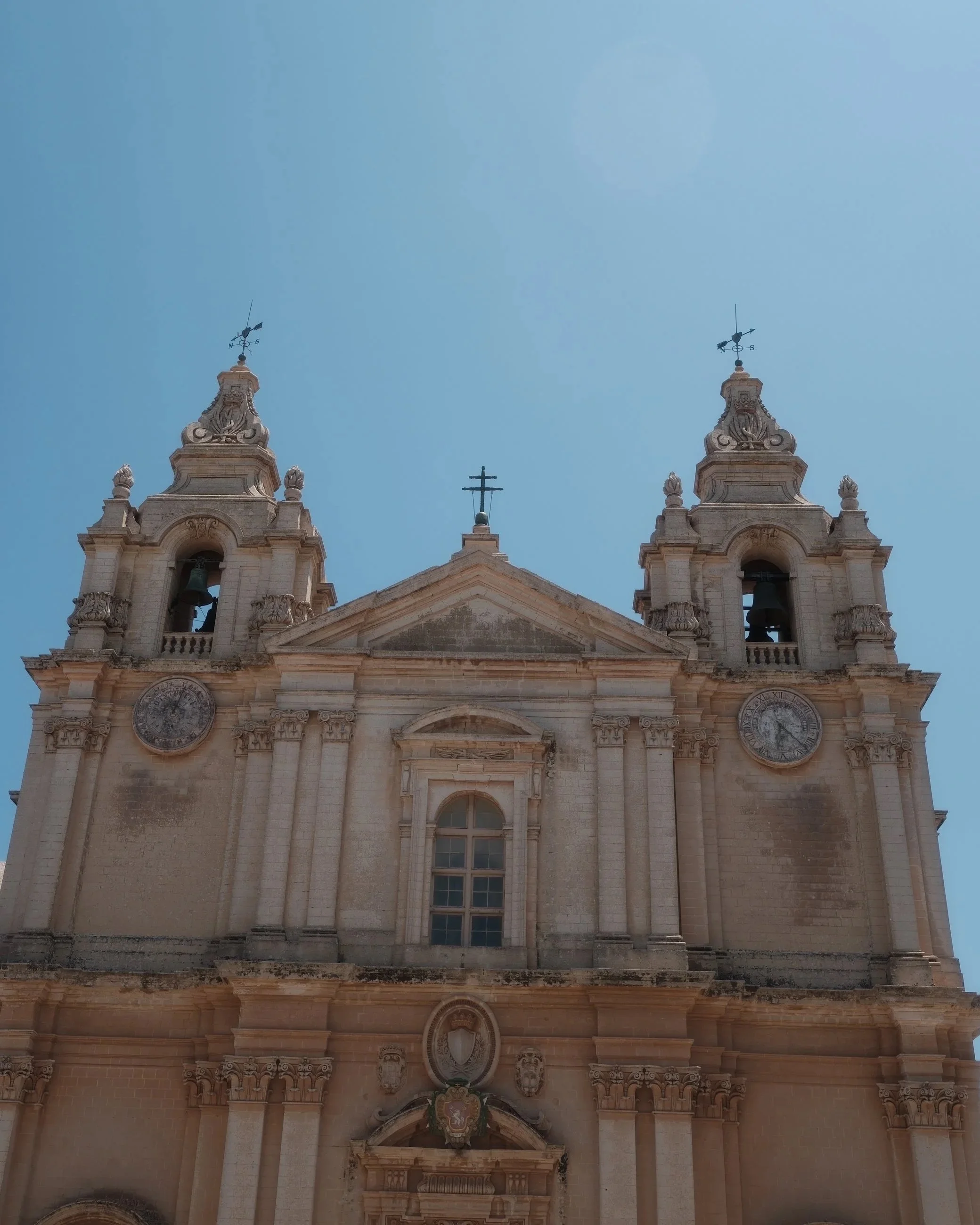
St. Paul Cathedral
Cultural Landmarks
St. Paul's Cathedral
At the center of the city stands St. Paul's Cathedral, a commanding example of Baroque architecture. Its dome anchors Mdina’s skyline, rising above the disciplined grid of limestone streets and acting as both landmark and orientation point. The façade is structured and balanced, reinforcing the city’s architectural order. Inside, marble floors, gilded detailing, and painted ceilings establish a sense of ceremony without excess. Light filters through high windows, illuminating chapels and altars with a quiet, controlled drama.
Adjacent, the St. Paul's Cathedral Museum houses ecclesiastical art, intricate paintings, rare coins, and religious relics, a reminder of the city’s historical significance beyond its visual charm. The collection is curated rather than overwhelming, allowing each object to be considered within context. Together, cathedral and museum reinforce Mdina’s cultural depth: compact, but substantial, a city whose scale is modest, yet whose legacy is enduring.
Dining & Atmosphere
Trattoria AD 1530
Dining in Mdina is inseparable from setting. At Trattoria AD 1530, tables extend into a stone courtyard framed by historic walls that retain the warmth of the day. The experience is atmospheric, candlelight reflecting against limestone, conversation contained within the architecture rather than carried beyond it.
There is a sense of enclosure that heightens the evening. Arched openings, textured façades, and softened lighting create depth without excess. The setting encourages a measured pace; courses arrive without urgency, allowing the surroundings to shape the experience as much as the menu. In Mdina, dining is not an interruption to exploration, it is a continuation of it, rooted in stone, proportion, and quiet refinement.
Step 15
It offers elevation, both literally and figuratively. Positioned along the bastions, it provides open views across the island, particularly compelling at sunset as the countryside shifts into muted gold and shadow. The vantage point reinforces Mdina’s unique geography, enclosed within, expansive beyond.
The pace is unhurried. Service follows the rhythm of the setting rather than accelerating it. In Mdina, meals feel like an extension of the streets, intimate, deliberate, quietly refined, shaped as much by atmosphere and perspective as by what arrives at the table.
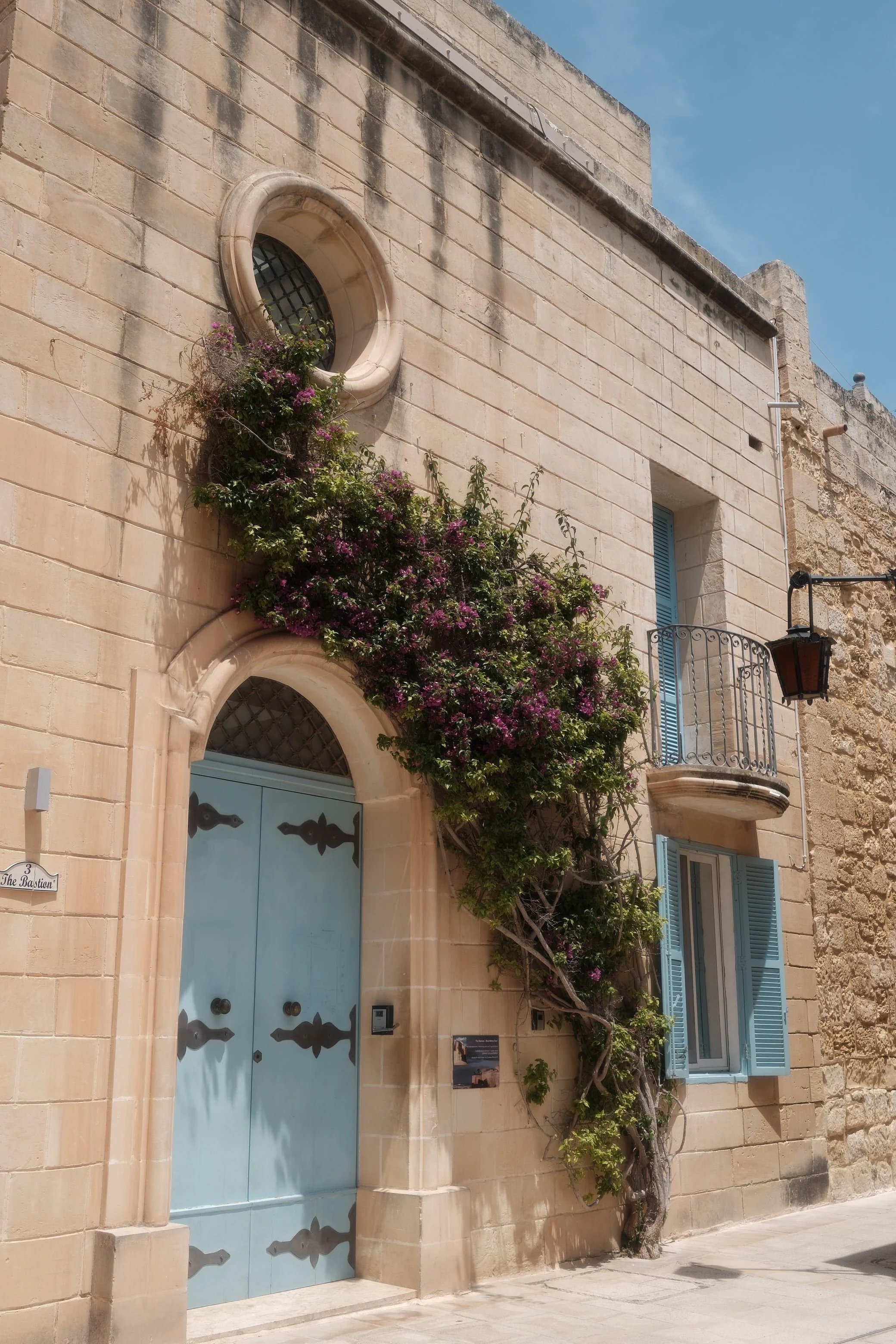
The Streets of Mdina
Beyond its landmarks and hotels, Mdina’s defining feature is its network of passageways. Florals cascade from balconies. Wooden doors are painted in saturated blues and greens, set against pale stone. Narrow alleys curve unexpectedly, revealing framed glimpses of domes and courtyards.
There is little need for agenda here. Mdina rewards slow walking and attentive observation. It is a city experienced through texture, limestone underfoot, shadow along walls, the subtle fragrance of flowering vines softening fortified edges.
Even the silence feels architectural. Sound is absorbed by stone, footsteps echo briefly and disappear, and the city seems to fold inward on itself. As daylight shifts, façades move from pale cream to deep amber, and the geometry of the streets becomes more pronounced. Mdina does not rely on movement to animate it; it relies on light, proportion, and the discipline of its design.
An Interior City
Mdina is not expansive; it is precise. Its appeal lies in proportion and atmosphere rather than scale. Within its walls, architecture, hospitality, dining, and heritage coexist in careful alignment. The city unfolds through measured details, a carved cornice catching late light, florals softening a limestone façade, a terrace positioned just beyond the reach of the afternoon sun.
Time behaves differently here. When the day visitors depart and the gates grow quieter, Mdina settles into its intended rhythm, contained, contemplative, self-possessed. The absence of noise becomes part of the experience; the architecture carries the narrative.
For the discerning traveler, Mdina offers something rare, a fortified city that feels both preserved and inhabited. It does not compete for attention. It holds it quietly, rewarding those willing to slow their pace and engage with its structure, its textures, and its restraint.
